
Davis Polk - Playbook (2029 London Training Contract)

Do you want a training contract at Davis Polk?
Here’s the research you need to impress!
This Playbook (3,001 words) covers
🏭 Why Buyers pick Davis Polk
📰 How publishers could unlock 24p a share
⚡ Who funded a nuclear firm’s Nasdaq debut?
🧱 $4.2bn in US bonds. Why London?
🙋 What sets Davis Polk apart
Plus, how to use these insights to stand out in your application and interview!
⏰ Deadline: 30 November
Why buyers call Davis Polk
In September, Davis Polk advised a company called Cerberus on its deal to buy most of Goodwin plc's (not the law firm!) mechanical engineering division for up to about £1.1 billion.
⭐ The deal is a great example you can discuss in applications and interviews to show Davis Polk's London strategy at work: act for US buyers taking divisions out of UK groups, and handle the whole separation, not just the purchase agreement.

What was the deal?
Goodwin will move its engineering businesses into a new company and sell it to Cerberus. The businesses serve the UK, US and Australian navies and support their AUKUS defence partnership.
Cerberus gets the benefit of the division’s profits from 1 May 2026. From that date, Goodwin gets an extra £174,372 a day on the sale price (not bad!).
The fee stops when the deal closes. If closing takes longer, it stops ten business days after the final condition is met.
🤔 So what's Davis Polk's strategy?
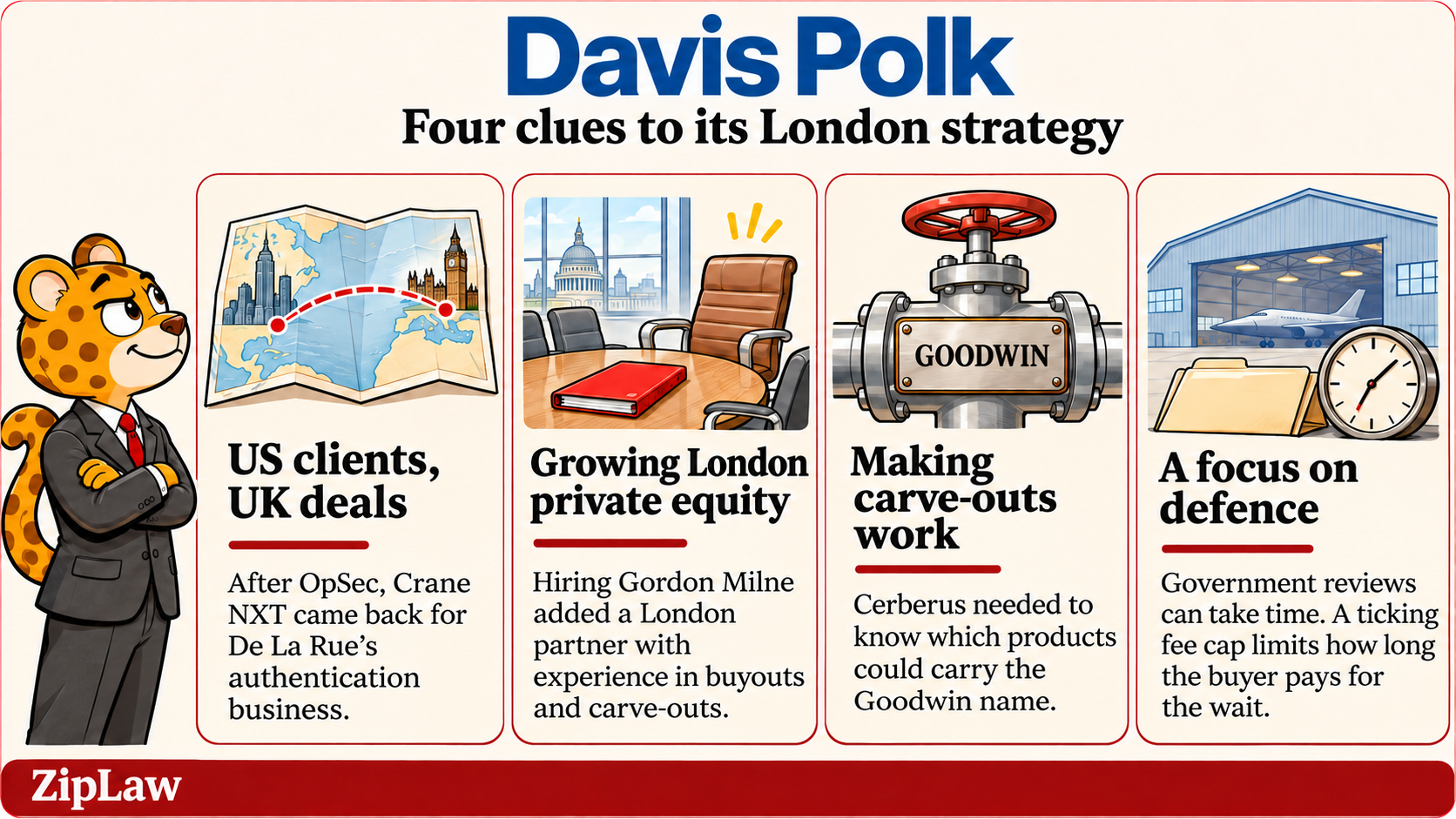
1. It follows US clients into UK deals. Cerberus is a repeat client: Davis Polk has also advised it on its investment in S+S Industries and the Amcor closures acquisition. Crane NXT followed the same path, with the OpSec acquisition first and then De La Rue's authentication division, led by London partner Will Pearce. The relationship starts in New York and London turns it into UK work.
2. It is building private equity capability in London. The firm hired Gordon Milne from A&O Shearman, whose practice includes carve-outs and public-to-private takeovers, and called London an area ripe for growth. Pearce points to private capital as a key driver of recent hiring, which has taken London above 60 lawyers. Goodwin is exactly the deal that hiring is meant to win.
3. It sells the separation, not just the purchase agreement. In a carve-out, value can be lost in the details. On Goodwin, the brand licence decides what Cerberus can call new products, which is why IP and commercial lawyers were on the team. On De La Rue, the sale depended on key customer contracts transferring. Different buyers, same problem: making sure nothing the business needs stays with the seller.
4. It is leaning into defence. Davis Polk pitches itself as the go-to firm across the aerospace, defence and space life cycle. Defence assets bring longer timetables and government scrutiny, which is why the ticking fee cap matters.
📊 The Trend to mention in Interviews
UK listed groups are reshaping themselves by selling divisions. Goodwin presented the sale as a way to unlock shareholder value and invest in its remaining Refractory Engineering and Technological divisions. De La Rue's sale was meant to let it repay its revolving credit facility in full and significantly reduce its pension deficit. On the other side are well-funded US buyers.
- US firms are competing hard for this work in London. Paul Weiss recruited more than 20 partners in about a year as it set out to build a top-tier private equity practice from scratch.
Davis Polk is taking a different route. It is adding targeted private equity and finance hires to an established London base: its London team, led by Takeover Code specialist Will Pearce, regularly advises on listings, takeovers and public and private M&A.
💡 How to use this in an application or interview
Join ZipLaw+ to continue reading