
How does Anthropic's $1.5tn IPO impact Law Firms?

Hi ZipLawyer! 👋
In today's Interview Brief, we're breaking down Anthropic's IPO and how to discuss it in application or interview.
We're covering:
💰 Why is Anthropic going public?
📈 What's the key market trend?
🏢 How does this impact businesses?
⚖️ How does this impact law firms?
🎤 What could a Partner ask you?
Let's get into it. 👇
⏱️ In Short
Anthropic, the company behind Claude, has filed for a potentially record-breaking IPO after generating extraordinary revenue growth and its first quarterly operating profit.
However, slowing growth, fierce competition and enormous computing costs raise questions about whether it can justify a $1.5tn valuation.

📝 What's going on?
- Anthropic published its IPO prospectus on 26 October 2026, preparing for a Nasdaq listing that investors expect could value the AI developer at $1.5tn–$1.75tn.
- Revenue reached $16.3bn in the first half of 2026, roughly 14 times the $1.2bn recorded a year earlier, reflecting surging demand for its AI products.
- Anthropic reported an $80.7bn net loss.
- The company faces enormous infrastructure costs having committed around $800bn over the next decade to support AI expansion.
- Anthropic's proposed ownership structure would give its seven founders 50.1% of general voting power, while its Long-Term Benefit Trust would have the right to appoint most directors.
📊 What's the Trend?
For years, software companies have attracted investors because they can sell additional subscriptions without proportionately increasing their costs.
AI is challenging that model. Every interaction with an AI system requires computing power, and the more advanced the AI sytstem, the more expensive the infrastructure.
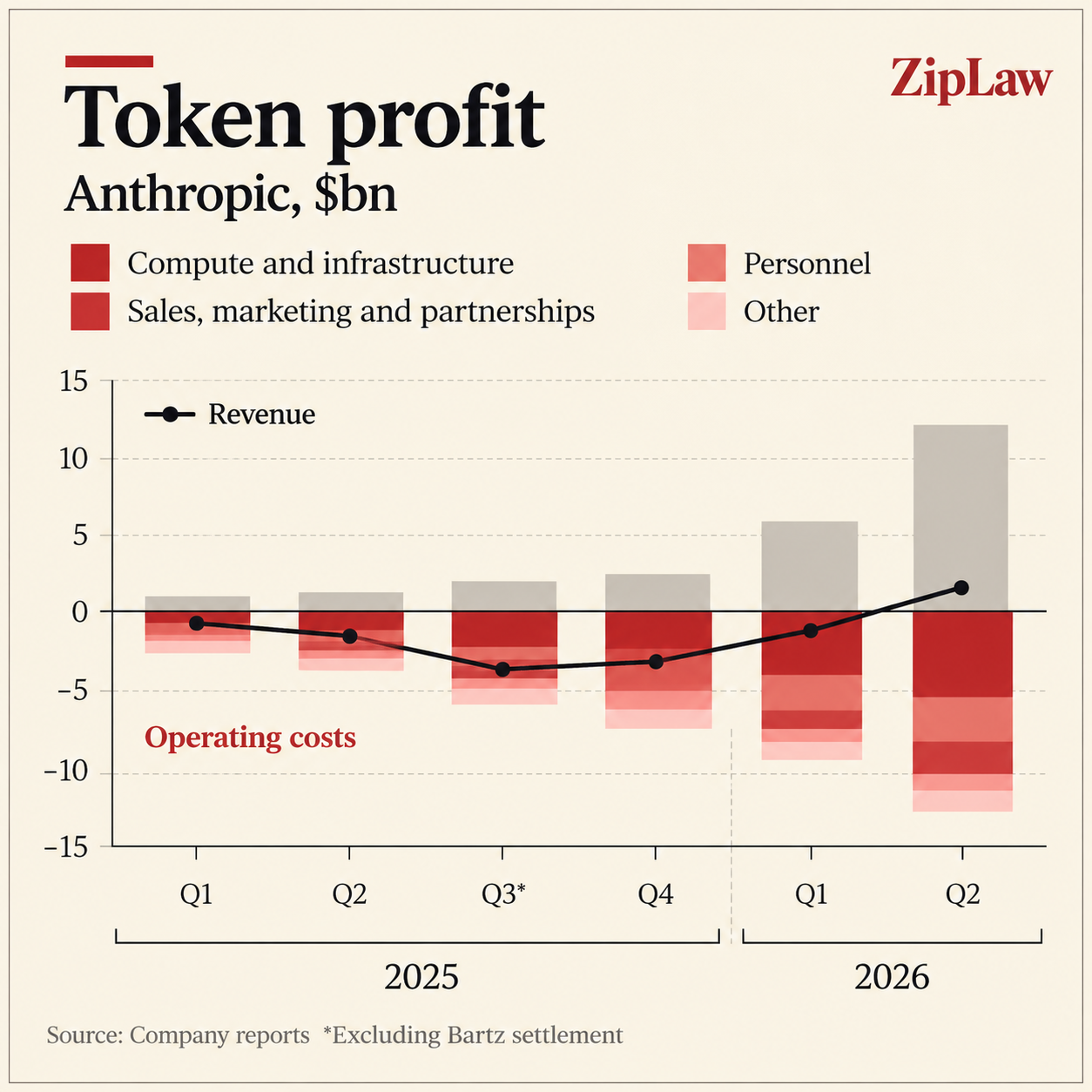
Anthropic has reduced its computing expenses from 251% of revenue in early 2025 to 48% in the second quarter of 2026. But, its decision to procure chips and dedicated infrastructure could require substantial upfront spending.
- This shows us there's a tension across the AI industry: the most successful developers may need to spend extraordinary amounts just to hold on to their competitive advantage.
So the question is no longer whether customers want AI, but whether providers can generate sufficient cash to fund its development.ß
💸 ßWhat does this mean for Businesses?
- Anthropic: Growth versus financial flexibility. Investing directly in computing infrastructure could reduce dependence on expensive cloud providers and improve long-term margins. However, equipment leases and fixed commitments create financial obligations that remain even if demand disappoints. Anthropic must balance securing enough capacity to compete with preserving cash and avoiding costly overinvestment.
- Cloud providers: Partners and competitors. Amazon, Microsoft and Google provide infrastructure and distribution channels for Anthropic, with cloud marketplaces accounting for 48% of its first-half revenue. These relationships generate significant commercial opportunities, but also create dependencies. As cloud providers develop competing AI products, Anthropic faces the challenge of relying on businesses that increasingly compete with it.
- Investors: Valuation versus future returns. A potential $1.5tn valuation reflects expectations of substantial future earnings, not simply current profitability. Investors must consider whether revenue growth can offset rising infrastructure costs and competitive pressures. Anthropic's first profitable operating quarter is encouraging, but sustained free cash flow, rather than headline revenue growth, will ultimately determine whether the investment delivers attractive returns.
⚖️ How does this Impact Law Firms?
Join ZipLaw+ to continue reading