
🛢️ Oil’s well
👋 Happy Saturday, ZipLawyer! Four astronauts splashed down in the Pacific off Los Angeles on Thursday after 237 days on the International Space Station. In that time they orbited Earth more than 3,792 times and travelled over 100 million miles. That’s roughly 200 round trips to the Moon.
NEWS ROUNDUP

🛢️ Oil’s well that ends well? G7 countries have agreed to release 100m barrels of oil and diesel from emergency reserves over four months to cool soaring energy prices. The move follows pressure from Donald Trump, who threatened to restrict US diesel exports unless Europe dipped into its reserves. With American midterm elections approaching, cheaper fuel has become something of a political emergency too.
🤖 AI chips are printing money: Samsung expects its third-quarter operating profit to jump a staggering 782% to $80bn, thanks to insatiable demand for the memory chips powering AI data centres. Even with profits approaching nine times last year’s level, investors are questioning how long the boom can last. Apparently, making $80bn in three months isn’t enough to silence Wall Street’s nerves.
💊 Boots gets a new prescription: Britain’s 177-year-old pharmacy chain is changing hands again after Canada’s billionaire Weston family agreed a £6.7bn takeover. The deal comes barely a year after private equity firm Sycamore Partners acquired Boots as part of its purchase of Walgreens Boots Alliance. For the new owners, the appeal is clear: a household name, more than 1,800 UK stores and a growing health and beauty business. Not bad for a company founded in 1849.
MORE NEWS TO KNOW
- 🌍 The IMF sounds the alarm: IMF chief Kristalina Georgieva has warned that soaring energy prices, mounting government debt and the AI spending boom are putting the global economy under strain. AI-related hardware now accounts for more than 10% of global goods trade, making the world’s economic fortunes increasingly dependent on the technology.
- 🇮🇳 India hits the brakes: India’s central bank raised interest rates to 5.5%, its first increase since February 2023, as inflation refuses to settle down. Markets expect further hikes, which could make borrowing more expensive for businesses and consumers across one of the world’s fastest-growing major economies.
- 💰 The $40bn shopping list: SpaceX is reportedly seeking $40bn in loans and bonds to buy Nvidia AI chips. Meanwhile, Nvidia has partnered with Wall Street heavyweights, including Apollo, on plans to mobilise more than $500bn for AI infrastructure. Its market value has climbed past $5.7tn. The AI boom isn’t just creating new technology; it’s creating an enormous business for the financiers funding it.
Gulf IPOs are Drying Up. Where is the Legal Work Going?
In short
The Gulf’s once-booming market for initial public offerings (IPOs), where companies sell shares to the public for the first time, has slowed sharply in 2026.
What’s going on?
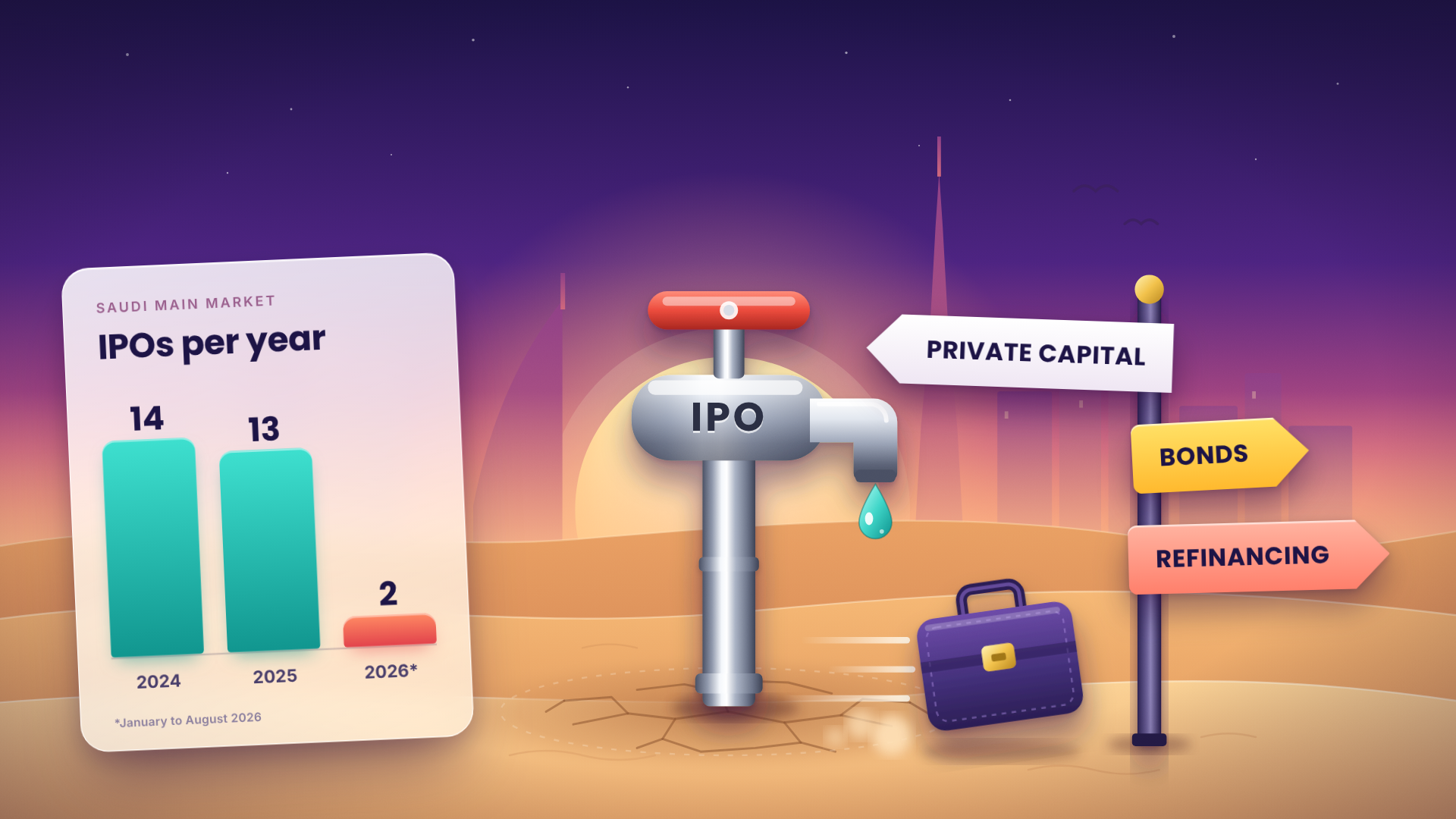
- The IPO boom has hit the brakes. Saudi Arabia’s main stock market recorded just two IPOs in the first eight months of 2026, compared with 13 across 2025 and 14 in 2024. Dubai and Abu Dhabi have also struggled to attract new listings, signalling a wider regional slowdown.
- Companies and investors cannot agree on prices. Geopolitical tensions have weakened confidence, but valuations are another sticking point. Business owners want to sell shares at attractive prices, while investors are demanding discounts to reflect greater risk. When expectations do not meet, companies often postpone their listings.
- Businesses are exploring other funding routes. Rather than selling shares publicly, companies can borrow through bonds, raise money from private investors or refinance existing debt. Each option serves a different purpose. Borrowing can fund expansion, for example, but does not allow an existing shareholder to cash out.
Why should I care?
- Access to capital is becoming more expensive. Companies still need funding even when stock markets are unattractive. Borrowing provides an alternative, but interest payments create ongoing costs and repayment obligations. A business that previously planned to raise money by selling shares may therefore need to reconsider its expansion plans or accept tighter financial constraints.
- Investors are gaining bargaining power. Companies seeking private investment may have to accept lower valuations or surrender greater control to secure funding. For example, an investor might demand a board seat or veto rights over major business decisions. That brings in capital today, but could restrict management’s freedom tomorrow.
- Private deals cannot replace every missing IPO. Mergers and acquisitions (M&A) activity has also weakened. EY recorded 390 Middle East and North Africa deals worth $46.7 billion in the first half of 2026, down from 434 deals worth $58.8 billion a year earlier. Although activity improved towards June, businesses and their advisers are competing for a more selective pool of transactions.
How does this impact Law Firms?
1. Debt Capital Markets and Banking
As companies replace planned share offerings with borrowing, debt capital markets lawyers could see greater demand from businesses issuing bonds or sukuk, financing instruments structured to comply with Islamic principles. Lawyers would negotiate repayment obligations, investor protections and restrictions on future borrowing. For example, a Saudi business facing an upcoming bond repayment might seek to issue new debt to repay the old borrowing. Its lawyers would examine whether existing financing agreements permit this, negotiate the new bond terms and coordinate repayment of the outstanding debt. The commercial objective is to secure funding without disrupting operations, although higher borrowing costs could make refinancing harder.
2. Corporate and Private Equity
Companies postponing IPOs may instead sell minority stakes to private equity funds or strategic investors. Corporate lawyers would negotiate share purchase agreements and shareholders’ agreements, which establish ownership rights and how important decisions are made. For example, a founder seeking to sell 25% of a business might want fresh investment without losing control. Lawyers could negotiate which decisions require investor consent, how board seats are allocated and whether the investor can sell its shares in the future. These protections help both parties reach a workable bargain. However, demand depends on investors remaining willing to transact at valuations sellers will accept.
3. Equity Capital Markets
Although fewer IPOs mean fewer immediate listing mandates, proposed Saudi regulatory reforms could generate additional advisory work for companies, investment banks and prospective issuers. Under the proposals, underwriters would assume binding purchase obligations earlier in the IPO process, while issuers would face greater requirements to disclose financial forecasts. For example, lawyers advising an underwriting bank might negotiate an underwriting agreement specifying when its commitment begins and how responsibilities are allocated if investor demand falls short. Lawyers advising issuers would also assess the legal disclosures accompanying management’s financial projections. This work becomes particularly important if the reforms are adopted and companies revive postponed listings.
ZipMemes