
Slaughter and May - Playbook (Training Contract 2029)
Do you want a training contract at Slaughter and May?
Here's the research you need to impress!
This Playbook (1,955 words) covers:
💰 Can Slaughters keep its M&A crown?
🔴 Slaughters' biggest threat
🧠 Unique Selling Points
🤖 Slaughters' AI Strategy
Plus, how to use these insights to stand out in your TC application and interview!
⏰ Deadline: 13 November
💰 Can Slaughters keep its M&A Crown?

What's going on?
Slaughter and May dominates UK corporate advisory work, but the market that made it successful is changing.
- £111.1m in potential fees: In September 2026, Slaughters was estimated to be in line for up to £111.1m in fees from five of the UK's ten largest announced takeovers, roughly double its nearest competitor.
- A FTSE powerhouse: The firm advises 31 FTSE 100 companies and 49 FTSE 250 companies, giving it direct relationships with some of Britain's most influential boardrooms.
- Expanding into private capital: Its Global Sponsors Group is developing relationships with private equity firms, private credit investors and infrastructure funds, including work for Arrow Global on a major European loan portfolio joint venture.
Why does this matter?
Slaughters' greatest competitive advantage is the long-term relationships it has built with Britain's largest companies.
Advising a FTSE 100 business can generate years of profitable work, from governance and financing to transformative acquisitions.
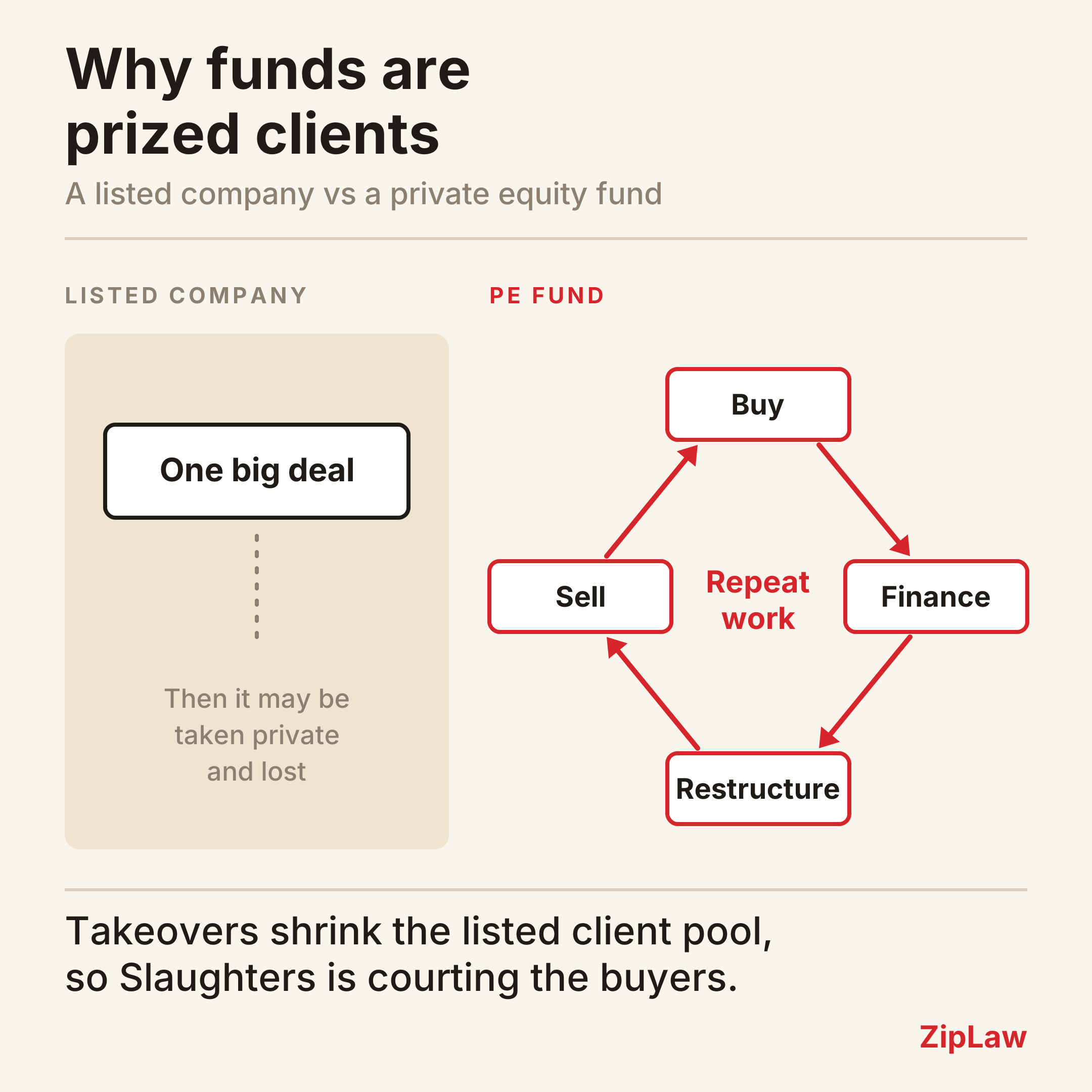
❗But there's a catch: as private equity investors and overseas buyers acquire more UK-listed companies, Slaughters risks losing some of the businesses that have traditionally supported its dominance. While these takeovers generate substantial fees in the short term, they could reduce the firm's pool of listed-company clients over time.
- Pivot time: This helps explain its growing focus on private capital, where relationships with investment funds can generate repeat instructions across acquisitions, financing and eventual exits.
BUT, moving further into private equity also creates a challenge for Slaughters' traditional business model.
Unlike some US rivals, Slaughters operates a more collaborative lockstep partnership, where partner remuneration is largely linked to seniority rather than individual revenue generation. This encourages teamwork and the sharing of client relationships, but makes it harder to compete with US firms offering enormous packages to attract highly profitable partners.
How to use this in your application
Join ZipLaw+ to continue reading