
The 'Slow' M&A Market is breaking Records: Here's Why
Most people think M&A is lying low right now. They're wrong.
If you've been following the news lately, you'd be forgiven for thinking that big business is keeping its head down:
- there's a war in the Middle East pushing oil above $100 a barrel;
- AI is shaking up the software sector; and
- it was only a year ago that Donald Trump's "Liberation Day" tariff announcements sent markets into a tailspin.
BUT here's the thing nobody's really talking about: the first three months of 2026 just produced the busiest dealmaking quarter in recorded history.

Wait... what's going on?
A total of $1.2 trillion worth of mergers and acquisitions were agreed globally in Q1 2026 (that's a lot).
There were 22 so-called "megadeals" agreed in just three months. A megadeal is any transaction valued above $10 billion. According to data from LSEG (the London Stock Exchange Group, 22 in a single quarter is a record.
This is also the third consecutive quarter where global M&A has topped $1 trillion. In other words, this isn't a one-off, there's a clear trend here.
Must-Know Deals
To make this feel real, here are some of the biggest transactions that landed in Q1:
- 🍲 Unilever sold its food division (think Marmite, Hellmann's, Knorr) to US spice giant McCormick, creating a combined business worth nearly $66 billion
- 👩🍳 Sysco agreed to buy Jetro Restaurant Depot for $29 billion. Two names you might not know, but Sysco is one of the world's largest food distributors, supplying restaurants across the US
- 🔋 Global Infrastructure Partners and EQT took energy provider AES private in a $33 billion deal.
Why is this suprising?
This is where it gets interesting, and where you'll have an edge over people who just skim the headlines.
The conventional wisdom is that geopolitical uncertainty kills dealmaking. When there's conflict, when oil prices spike, when markets wobble, boards tend to go into what's called a "risk-off" mentality. That means: sit tight, don't make big bets, wait for clarity.
That hasn't happened. So what's driving deals instead? A few things:
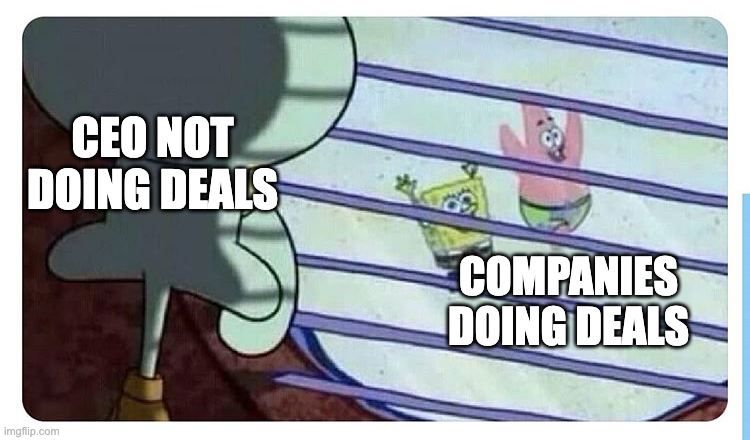
1. Boardroom FOMO When your competitors are acquiring and consolidating, staying still stops feeling like caution and starts feeling like a strategic failure. Boards are under real pressure to show shareholders and markets that they have a growth story, and in the current environment, organic growth alone isn't cutting it. The result is a self-reinforcing cycle: the more deals that get announced, the more pressure mounts on those who haven't moved yet.
2. A deal-friendly regulatory environment Under the Trump administration, US antitrust authorities (the bodies with the power to block deals on competition grounds) have been far less interventionist than they were under Biden. For CEOs who spent years watching deals collapse under regulatory scrutiny, that shift is a big deal. Experienced dealmakers will want to make the most of this.
3. Depressed prices as a buying opportunity This is the counterintuitive one. Market turbulence caused by the Middle East conflict has pushed some company valuations down, not because those businesses are fundamentally weaker, but because broader investor nervousness has dragged share prices with it. For a cash-rich buyer with a long-term view, that is exactly the moment to move. You are buying a quality asset at a discount created by macro conditions rather than any real issues in the business itself.
It's not all good news!
None of this means dealmaking is without risk. There are a few pressure points you need to know:
1. The private equity machine is stalling. Private equity firms (think investment funds that buy companies, improve them, and sell them for a profit) are sitting on a huge backlog of companies they haven't yet exited. The number of PE-backed deals was down 12% to a six-year low in Q1. Despite the overall boom, the regular PE deal market is slower and more selective.
2. Tech deals are struggling. Technology is usually the single biggest sector for M&A. But with AI disrupting software company valuations and investors jittery about the sector's future, tech dealmaking is subdued. A slowdown in a sector this large has an outsized drag on overall deal volumes, which is why the record numbers may prove harder to sustain as the year progresses.
3. Oil prices and private credit. With oil above $100, the cost of everything goes up, and that hasn't fully fed through to the wider economy yet. Meanwhile, private credit (i.e. the market where non-bank lenders provide financing for deals) is showing signs of stress in its exposure to struggling software companies. Private credit has become an enormous source of deal financing over the past decade, so instability there matters.
What does this mean for Law Firms
Here are the must-know trends and opportunities you need to know to impress law firms in your applications, interviews and ACs!
Join ZipLaw+ to continue reading